
Introduction: The $2,000 Morning Habit
We need to talk about your morning routine. You wake up, you get dressed, and you head to your local coffee shop. You stand in line for 10 minutes. You shout your order over the noise of the grinders. You pay $6.50 (plus a $1 tip) for an oat milk latte that is, frankly, hit or miss.
It doesn’t feel like a lot in the moment. But do the math.
- $7.50 per day x 5 days a week = $37.50/week.
- $37.50 x 52 weeks = $1,950 per year.
And that’s just for one person. If you and your partner both grab a coffee, you are looking at nearly $4,000 a year spent on bean water and steamed milk.
For that price, you could fly to Italy. Or, you could invest in a machine that not only pays for itself in six months but actually makes better coffee than the shop down the street.
Breville has democratized specialty coffee. They have taken the massive, $20,000 La Marzocco machines found in high-end cafes and shrank the technology down to fit on your kitchen counter. They didn’t cut corners; they just cut the size.
In this guide, we are going to ignore the toasters and blenders and focus 100% on Coffee. We will explore the science of the “God Shot,” compare the top Breville models, and show you how to turn your kitchen into the best cafe in town.
👉 Ready to fire your barista? Click here to shop Breville’s Espresso Lineup with exclusive offers!
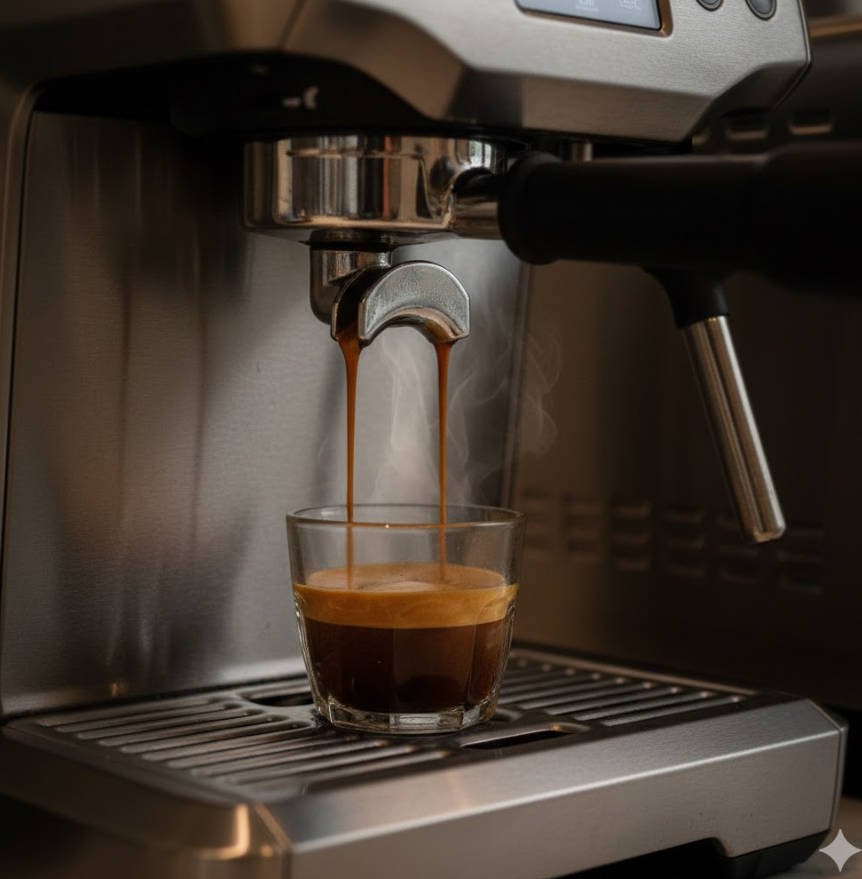
Part 1: The Science of “Third Wave” Coffee (Why Keurig Doesn’t Cut It)
To understand why you need a Breville, you have to understand why your current coffee maker sucks. Standard drip machines or pod machines (like Keurig/Nespresso) prioritize convenience over chemistry. They use stale, pre-ground coffee and water that is often too hot or too cold.
Breville machines are built on the “4 Keys Formula” of Third Wave Specialty Coffee. This isn’t marketing fluff; it’s physics.
- Rich, Full Flavor (Dose): You need 19-22 grams of coffee to create a rich, syrupy body. Pods only hold 5-7 grams. Breville’s 54mm and 58mm portafilters hold the full, commercial dose.
- Perfectly Balanced Taste (Temperature): Coffee is volatile. If the water is 205°F, it burns the beans (bitter). If it’s 190°F, it’s under-extracted (sour). Breville uses PID Digital Temperature Control to keep the water at exactly 200°F (93°C).
- Irresistible Body (Pressure): You need 9 bars of pressure to emulsify the oils in the coffee bean, creating that golden foam on top called “crema.” Breville uses a low-pressure pre-infusion to soak the puck before hitting it with the full 9 bars.
- Silky Mouthfeel (Steam): To get that velvety latte texture, you need steam that is hot enough to create thousands of “micro-bubbles.” Breville steam wands generate high pressure (266°F) to turn milk into “liquid paint” perfect for latte art.
Part 2: Choosing Your Weapon (The Lineup)
Breville offers a machine for every level of enthusiasm. Are you a hobbyist who wants to tinker? Or do you just want caffeine immediately?
1. The Purist’s Choice: The Barista Express®
- Price Tier: Mid-Range ($)
- The Vibe: This is the Toyota Tacoma of espresso machines. Rugged, reliable, and manual.
- The Workflow: You weigh your beans. You grind them into the portafilter. You tamp (press) the grounds down yourself. You lock it in, pull the shot, and steam the milk manually.
- Why Buy It: It forces you to learn the skill. There is a deep satisfaction in dialing in your grind size and pulling a shot that looks like melted chocolate. It features an analog pressure gauge that tells you exactly what’s happening inside the machine.
2. The Smart Middle Ground: The Barista Touch™ Impress
- Price Tier: Premium ($$)
- The Vibe: A helpful robot barista living in your kitchen.
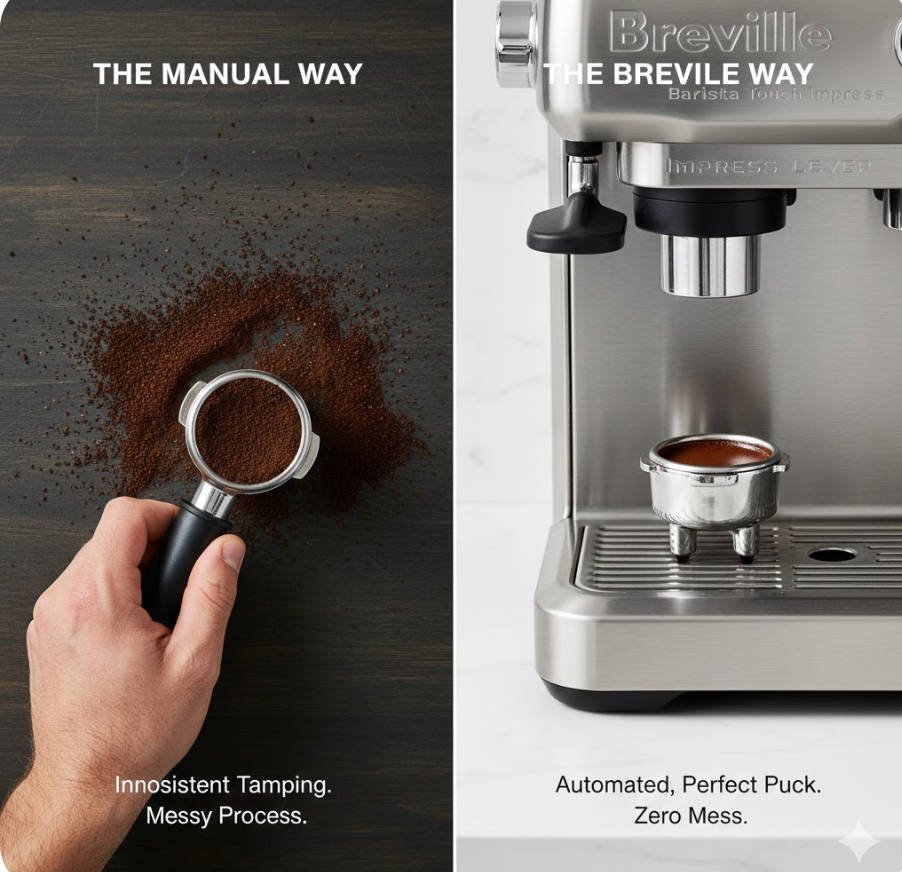
- The Problem It Solves: Tamping is hard. If you press too hard, the water can’t get through. If you press too light, the water rushes through.
- The Solution: The Impress™ Puck System. You grind the beans, and then you pull a lever on the side of the machine. It mechanically tamps the coffee with exactly 22lbs of pressure and gives it a 7-degree polish. It effectively removes human error from the equation.
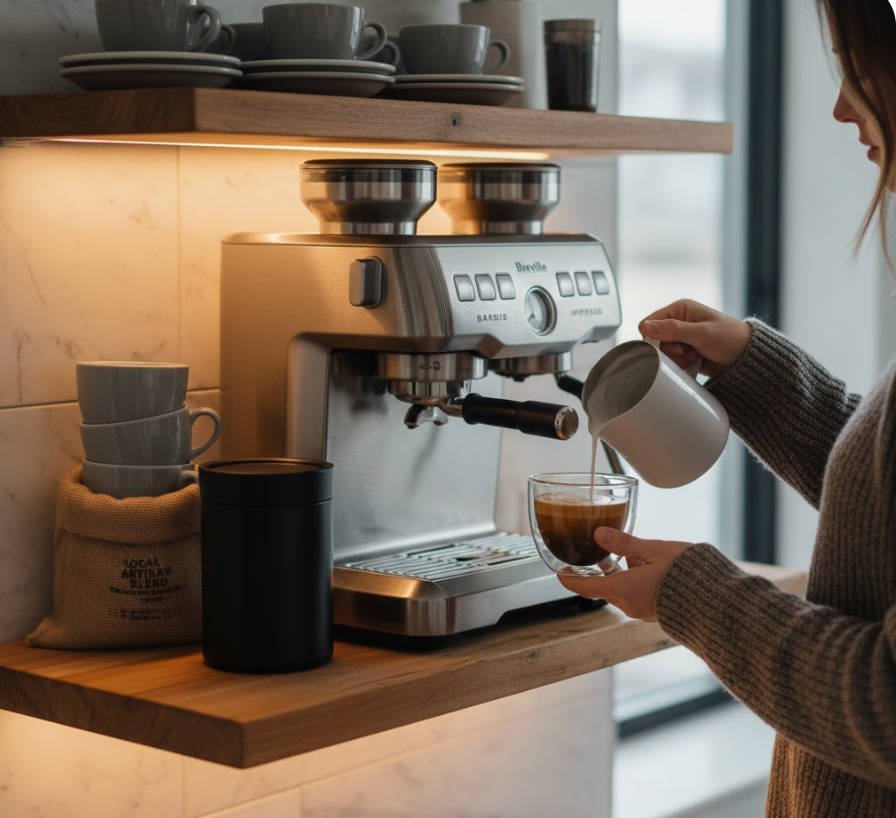
- The Milk: It features Auto MilQ™. You select your milk type (Oat, Almond, Dairy, Soy) on the touchscreen, place the jug under the wand, and hit “Start.” The machine automatically texturizes the milk to your desired temperature and foam level.
3. The Ultimate Luxury: The Oracle® Touch
- Price Tier: Luxury ($$$)
- The Vibe: Having a commercial cafe in your house, but with an iPad interface.
- The “Dual Boiler” Difference: Most home machines have one heater. You have to pull your shot, wait for the machine to heat up, and then steam your milk. The Oracle has two independent stainless steel boilers. You can brew espresso and steam milk at the exact same time. This cuts your drink-making time in half.
- Automation: It grinds, doses, and tamps automatically. You just move the handle from the grinder to the brew head.
Part 3: The Secret to Great Coffee (The Grinder)
Here is a secret most people don’t know: The grinder is more important than the machine. If your coffee grounds are inconsistent (some big chunks, some dust), the water will flow unevenly, tasting both bitter and sour.
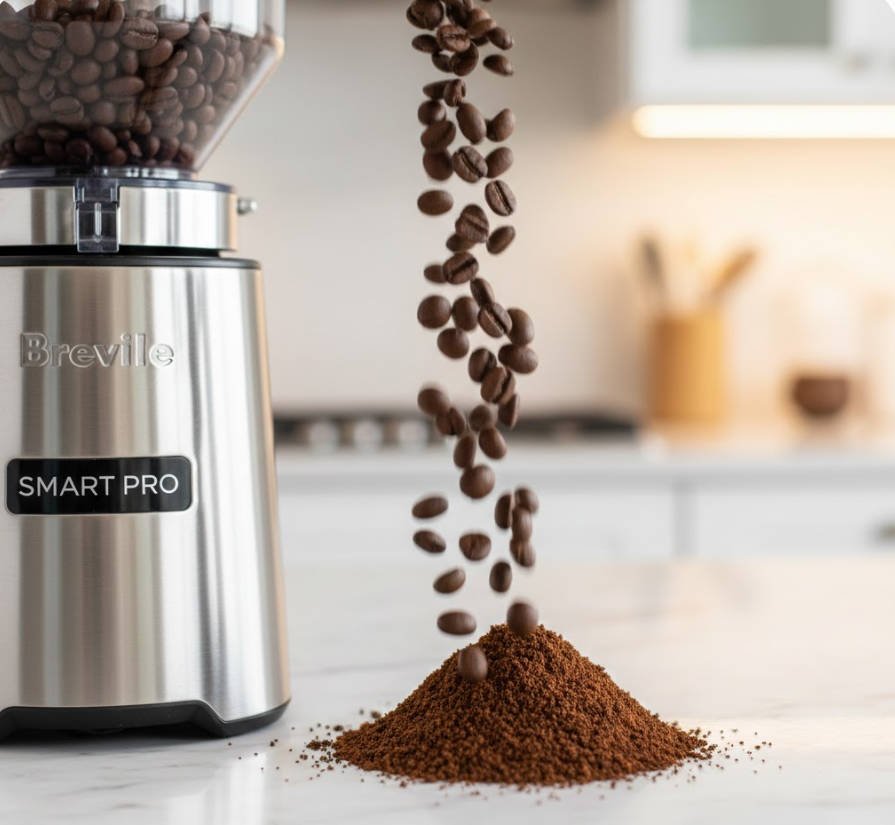
Breville’s integrated grinders (found in the Barista and Oracle series) use Stainless Steel Conical Burrs. Unlike “blade grinders” (which just chop beans randomly), burr grinders crush the beans to a precise, uniform size.
- Adjustability: You can tweak the grind size. If your shot is running too fast (watery), you make the grind finer. If it’s too slow (dripping), you make it coarser. This control is the key to unlocking flavor notes like “blueberry,” “chocolate,” or “jasmine” hidden in your beans.
Pro Tip: If you buy a machine without a grinder (like the Bambino Plus), pair it with the Breville Smart Grinder™ Pro. It has 60 unique grind settings and digital dosing timers.
Part 4: ROI Analysis (The Latte Math)
Is spending $800 – $2,000 on a coffee machine crazy? Let’s break it down.
The Cafe Scenario:
- Daily Latte: $6.50
- Yearly Cost: $2,372.50
The Breville Scenario (Year 1):
- Cost of Machine (Barista Touch): ~$1,000
- Cost of Good Beans (1lb/week at $18): $936
- Cost of Milk ($4/week): $208
- Total Year 1 Cost: $2,144
The Result: By the end of Year 1, you have already saved money (~$200). The Breville Scenario (Year 2):
- Cost of Machine: $0
- Beans + Milk: $1,144
- Total Year 2 Savings: $1,228.50
Over a 5-year period (the typical lifespan of a well-maintained machine), owning a Breville puts over $5,000 back in your pocket. That is a significant return on investment.
Part 5: Beyond the Machine (Accessories & Maintenance)
To truly live the barista lifestyle, you need a few accessories. Breville thinks of everything.
- The Knock Box: Where do you put the hot, wet puck of coffee grounds after you brew? You need a “Knock Box.” It’s a small bin with a rubber bar that you bang the portafilter against. It’s satisfying and keeps your trash can clean.
- The Puck Sucker: Yes, that’s the real name. For the Oracle series, Breville released a device that uses a vacuum to suck the puck out of the portafilter silently. No banging required.
- Water Filters: 98% of coffee is water. If your water tastes like chlorine, your coffee will too. Breville machines come with charcoal water filters in the tank. Change them every 3 months.
- Cleaning Tablets: Coffee oils build up inside the machine. Every few months, the machine will light up a “Clean Me” light. You drop a tablet in and run a cycle. It’s easy.
Part 6: How to Choose? (Summary Guide)
- Buy the Barista Express IF: You have a budget under $800, you want to learn a new skill, and you enjoy the ritual of manual crafting.
- Buy the Barista Touch Impress IF: You have a budget under $1,500, you want mess-free tamping, and you want automatic milk texturing for plant-based milks.
- Buy the Oracle Touch IF: Budget is no object ($2,500+), you entertain guests often (speed is key), and you want the absolute best machine money can buy.
Conclusion: Wake Up to Better
There is a moment when you take your first sip of a latte you made yourself—when the foam is perfect, the temperature is just right, and the flavor is rich and chocolatey—that you realize you can never go back to the drive-thru.
Breville gives you the power to start your day with excellence. It turns a caffeine addiction into a culinary art form.
Stop burning your money on mediocre coffee. Build your sanctuary.
Ready to pull the perfect shot?
(Note: Breville offers free shipping on all espresso machines, plus a 2-year warranty on premium models.)
FAQ: Home Barista Questions
Q: Is it hard to learn how to use these machines? A: It depends on the model. The Barista Express has a learning curve (maybe 1-2 weeks to get perfect). The Touch and Oracle series are intuitive right out of the box, with on-screen tutorials that guide you through making your first coffee.
Q: Can I use regular store-bought beans? A: You can, but you shouldn’t. Most supermarket beans were roasted months ago. For the “God Shot” (lots of crema), you need fresh roasted beans (roasted within the last 2-4 weeks). Check the “Roasted On” date on the bag.
Q: Does Breville make a cold brew machine? A: Yes! While their espresso machines can make an “Iced Latte,” if you want true Cold Brew, check out the Breville Precision Brewer®. It has a dedicated “Cold Brew” setting that steeps the coffee over a long period.
Q: What happens if the machine breaks? A: Breville USA has excellent customer support. Premium machines like the Dual Boiler and Oracle come with a 2-year limited warranty. They also offer a repair program where you can send the machine in for service.